Language is a skill that has guided me through life. Every opportunity I’ve encountered has stemmed from how I write, present, and help others communicate. Because of this, I make it a priority to teach my boys the proper use of English. Here are a few tips I use, and I hope you’ll find them useful too!
1. Don’t provide answers
Whenever my boys ask me how to spell a word, my response is always the same: “You try first.” They need to attempt to spell the word by sounding it out. I only step in with the correct spelling when they struggle with tricky parts like silent vowels or homophones.
2. Read weird stuff
The strange, the funny, and the weird tend to stick in children’s memories. Part of our regular reading ncludes works by Edward Lear, like “The Quangle Wangle Quee” and “The Owl and the Pussycat,” as well as books by Dr. Seuss. It doesn’t matter if some words are nonsense—children delight in the sounds and rhymes, even if they don’t fully understand the meaning.
3. No such thing as “big words”
In our home, there’s no such thing as a difficult word. We treat all words equally, whether they’re dinosaur names, scientific terms, or multi-syllable words. Words like “Parliament,” “jurisdiction,” “election,” “metamorphosis,” and “camouflage” frequently pop up in our conversations.
4. Introduce Big Concepts Gradually
While we’re comfortable with big words, big concepts need to be introduced slowly. This is the fun part—each conversation is an opportunity to learn something new. For example, talking about Parliament naturally leads to discussions about elections, voting, rights, and the separation of powers.
5. Engage in Lots of Conversation
Talk about everything and anything. Children are naturally curious and will ask endless questions. Take the time to answer thoughtfully, explaining in a way they can understand. Keep expanding the boundaries of what they can grasp—you might be surprised by how much they can take in!
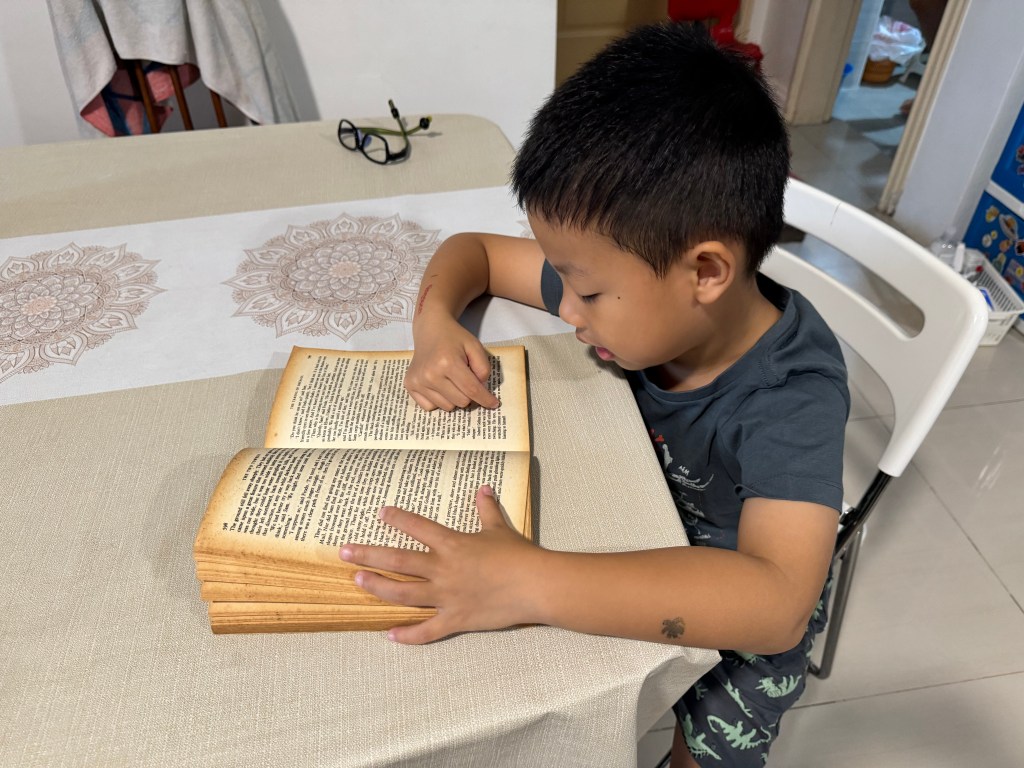
(No he can’t read that whole book yet..it’s the Lord of the Rings! But he’s being entertained by reading the paragraphs of Smeagol having a monologue.)
6. Encourage Complete Sentences
In Singapore, we often shorten our sentences: “You go where?” “You eat what?” “Got peanut butter or not?” While this is common, it’s not good sentence construction. I regularly remind my boys to “Ask a full question please,” or “Use a full sentence please.”
7. One thought, one sentence
In their eagerness to share, children sometimes string together long chains of words, making it hard to understand their point.
You know, those that go: “And then I went to the park and I saw a big doggie and he was running really fast and and and I wanted to play on the swing but the swing was soooo high and so I asked Mommy to help and there was a bird and it was flying and I wanted to fly too but I can’t fly so I ran really fast like the doggie and then I got tired. Oh and and we had a snack and I had a cookie and it was so yummy.”
When this happens, I ask them to pause, think of just one thing to say, and express it in a single sentence. Then I would repeat each sentence and help them build up the full paragraph.
8. Check for comprehension
Here’s a trick I use when reading to my boys: I stop mid-way and check their understanding. For example, while reading “Jack and Jill,” I might ask, “Who ran up the hill? Why did they go up the hill? What’s a crown? Why do you think it’s called a ‘crown’?”
9. Make Deliberate Mistakes
Have you noticed how eager people are to correct mistakes? It’s the same with children! Sometimes, I deliberately make mistakes to test their comprehension and alertness. I might point to a word and read it incorrectly, then watch as they explain why I’m wrong.
10. Keep Learning Fun
This is crucial—everyone loves to learn, but nobody likes being taught.
I try to make learning fun for my boys. With boys, learning often needs to be physical. For example, I might have them walk around the house, touching objects and telling me whether we use “a,” “the,” or “an.”
When they first started learning to read, I remember a time when I lost patience and got frustrated when one of them couldn’t remember a pronunciation. He then had the poor-thing-want-to-cry face, and I felt so bad. Since then I keep myself in check and not let myself lose it like that. A bad moment could hurt the child’s interest in the subject forever.
What are your techniques? Feel free to share with us!



 Queuereus - Journaling our learning
Leave a comment