
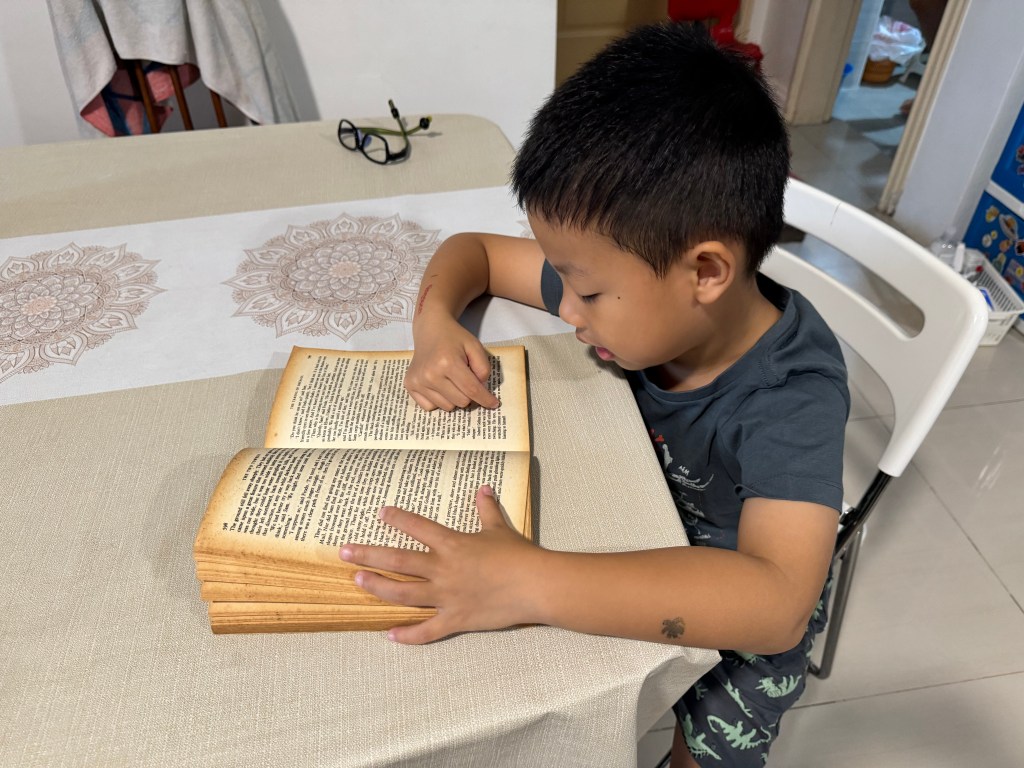
I’m teaching my boys that maths is first about language, before it is about numbers. After all, describing the problem is half the battle.
If only I had learned this back when I was in school, I might have turned out quite differently.
My biggest problem is that I cannot get over the “why.” Not “why” as in, why do we have to learn maths, but “why” as in, “Why do we have to balance an algebraic equation?” “Why does anybody write a numerator bigger than a denominator?”
These are really language and logic problems. What are we trying to find out? What IS the problem?
The reason the numerator is bigger is because they are not proper fractions. You need them because, in the future, it helps to compare subjects that are not equal. For now, there is no need to fear them… because they’re simply dressed “improperly.” It works – last weekend, I spent an hour explaining this to the boys, and they got it quite quickly. We will discuss this in the future when I expand their learning about fractions.
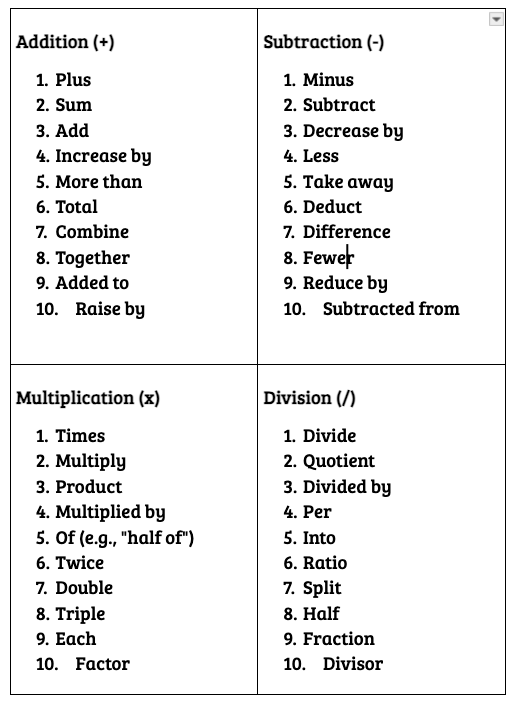
So here we are at Day 1. The lesson is really about how to say +, -, ×, and ÷ in different ways. If you want to download the Google doc, here’s the link , and feel free to add to it.
Then there are location words: left and right, before and after, up and down. That’s easy.
The next big word to learn is “ordinal,” thus called because things happen in order.
When we count upwards, everything increases by 1 in that order: 1, 2, 3, 4, and so on. The ordinal way of saying things is 1st, 2nd, 3rd, 4th, and so on.
Ordinals are important because everything in the Universe is in order. God is a God of order. Electrons in an atom are so arranged because they need to conform to stability and order. From the arrangement of planets in our solar system to the precise patterns of a snowflake, order is evident. In mathematics, ordinals help us understand sequences and hierarchies, providing a way to organize and compare sets.
In biology, the taxonomy of species reflects the order of life forms based on God’s designed relationships and hierarchical rules. In physics, the laws of thermodynamics dictate the order of energy transformations. Even in human society, order manifests in our legal systems, social structures, and cultural practices. It provides a foundation for justice, cooperation, and progress. Without order, chaos would prevail, leading to uncertainty and instability.
Ordinals and order are fundamental to existence.
Of course, I used language appropriate for 5-year-olds to explain all that.
You pair location words with an understanding of order, and they can soon understand how to answer questions like this:
There is an apple, an orange, a watermelon, a pear, a durian, and a mango. The mango is first from the right. The watermelon is between the orange and durian. The orange comes after the mango. The durian comes after the apple.
How many fruits are there altogether? In which position is the durian? Which fruit is the last?
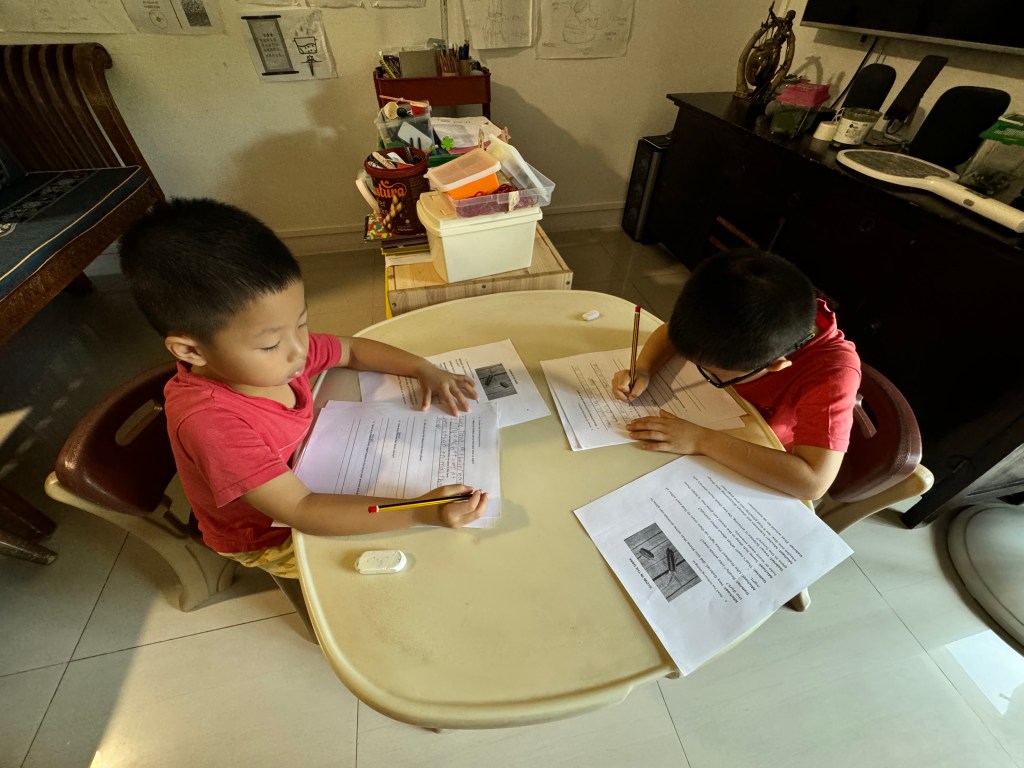
The skills learned from these questions form the backbone of arithmetic, and it helps to practice the verbal gymnastics consistently.



 Queuereus - Journaling our learning
Leave a comment