If you’ve tried looking for worksheets on the internet, you’ll find that they fall into one of these categories:
- Too expensive
- Too American
- Too simple
- Doesn’t align with the Singapore curriculum
- Doesn’t have meaningful content
So I’m going to start making my own worksheets! The best thing about this is that we can design them to include a wide breadth of learning. For example, comprehension must include references to God, science, daily life, expanding vocabulary, and so on.
In the first set of sheets, I created three activities: a dialogue reading, a prose reading, and a short lesson on the usage of tenses.
I may have been too ambitious, haha. They could only manage two activites out of 3 within the hour.
They loved the dialogue reading! I explained that this was how actors did their work. They would memorize entire stacks of lines and then focus on delivering them well. This could be fun; perhaps we can do a short acting class in the future.
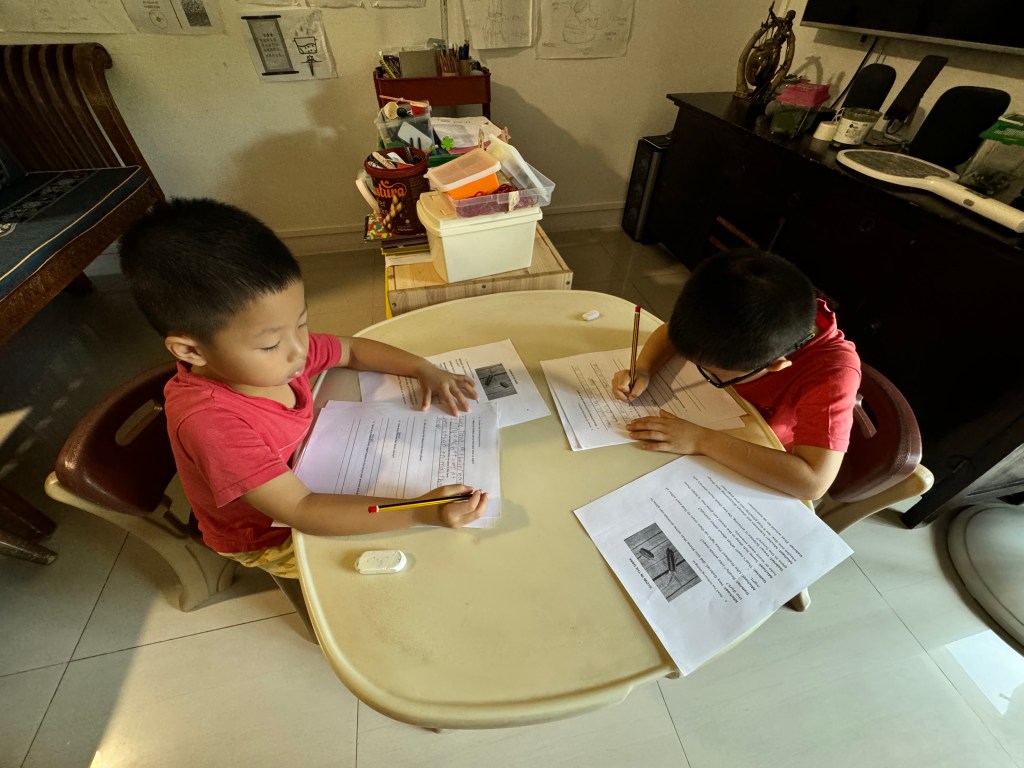
Since these are their first lessons in answering questions, it took some time to explain how to answer them in complete sentences.
For example, if the story is about bananas and the question asks, “What color is a banana?” you want the written answer to be: “The banana is yellow.” And the answer must come from the story, not from what you know.
I know that in school, they have a framework for answering these questions. You take a word from the question (e.g., banana), include an answering operator to it (e.g., the), then find the sentence in the story and connect them all.
I don’t like frameworks like this. It is a shortcut to getting answers, but you learn nothing. When you encounter situations where the exact words are not found in the story, you panic because you can’t craft this model answer anymore.
So the process I have is this:
Explain the concept of a complete sentence.
Very often, we answer in single words. What color is the banana? Yellow.
So I explained that answering this way is unclear. Then they would say, “It is yellow.” Then I’d go, “What is ‘it’?” You want to be as clear as you can, using as many words as necessary to explain a question properly.
This stage is the longest, and we practice this whenever possible.
Look out for what the question is asking.
In our worksheet, one of the questions was, “Why do some fish deep in the ocean glow?” I find that at the start, they get thrown off by the variety of concepts in this question.
So the trick is to break it down: Why do (that’s an important piece), some fish / deep in the ocean / glow?
This just takes practice and an expansion of vocabulary. By breaking the sentence into smaller parts, your brain will digest each piece better.
This gives me an idea – perhaps we can do an exercise solely on understanding questions alone.
Look for the answer in the story.
This is important. In academic work, the answer cannot come from what you know. It must be evidenced in the material provided. So you now hunt the story paragraph by paragraph. At this stage, when the passages are short, it would be easy.
Finally, write your answer.
Many questions can be answered by returning words from the question. For example:
Q: “Name one other animal mentioned.”
A: “One other animal is…”
Q: “What do fireflies use…”
A: “Fireflies use…”
Earlier, I taught them that you cannot answer a question with words from the question. This confused them a little.
What I meant was, when someone asks, “What is a chicken?” you cannot answer, “A chicken is a chicken.” So I had to explain in more detail what this meant.
An answer has two parts: an introduction and the answer itself. The introduction can use words from the question. The answer itself cannot.
If you’d like to use the worksheets too, follow this link: https://docs.google.com/document/d/1Iz_r73DnR3Ga5Nw90wPRqSaye0kbEPFybKfJ0bkuQsI/edit?usp=sharing
Please do share your experience with me!



 Queuereus - Journaling our learning
Leave a comment